Inscription and Re-entry
This section engages debates around personal identity (Parfit, 1984), pattern theories of mind (Hofstadter, 1979; Dennett, 1991), the philosophical literature on resurrection (van Inwagen, Baker, Zimmerman), morphic resonance (Sheldrake, 1981) (empirically contested, but the formal structure of the proposal remains useful as a target), the holographic principle (Susskind, 't Hooft, Maldacena), and contemporary "digital afterlife" technologies. Most existing treatments either dissolve the question as confused or accept its religious framing uncritically. The contribution: separating the question into three claims of escalating strength, formalizing the third as an attractor-inheritance hypothesis on a typed causal hypergraph, and specifying what evidence would distinguish it from reconstruction-by-records.
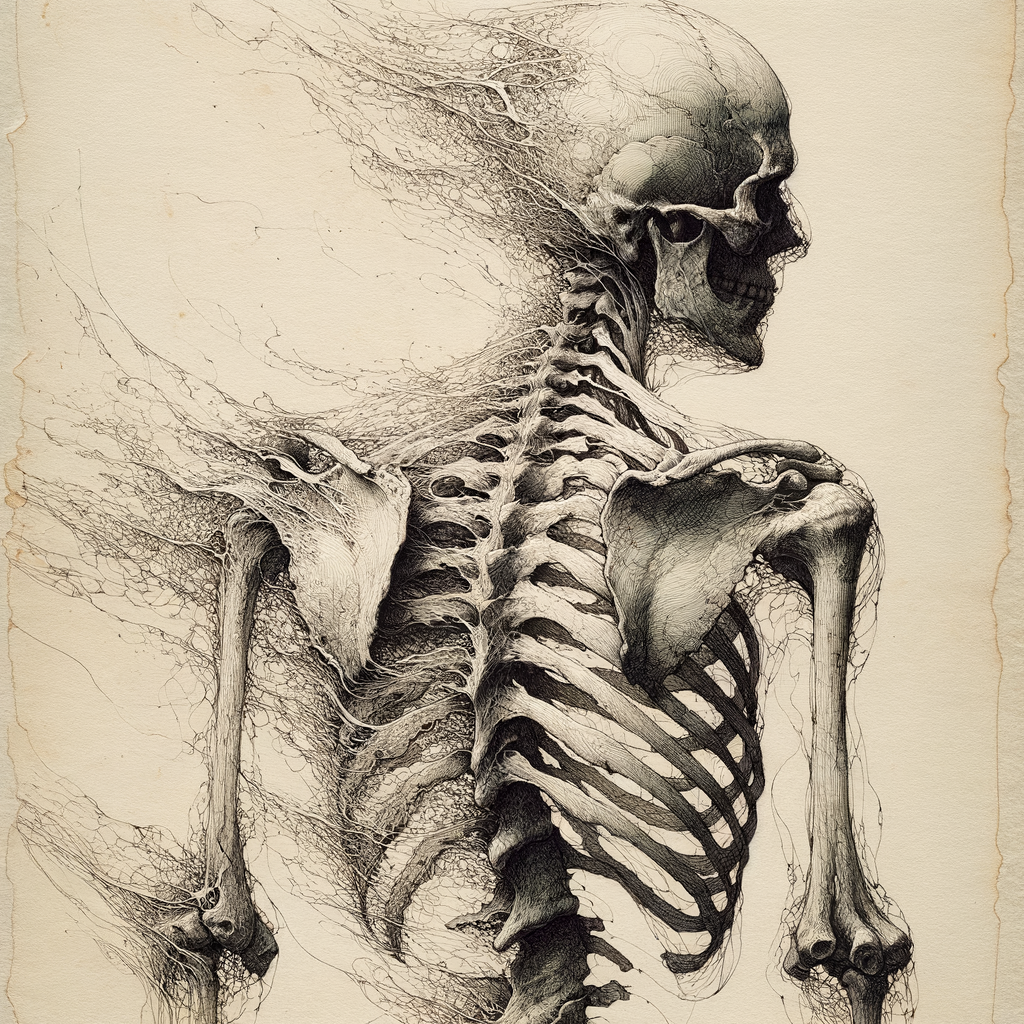
The framework began with a claim about substance: there isn't any. What you experience as a solid object is a stable compression over field interactions — mostly empty space resisting interpenetration through electromagnetic structure, a pattern your nervous system reports as a thing because the report is useful at the scale you operate. The cup is real. The hand is real. But neither is real in the way the folk ontology of breakfast assumes. So when someone says "the person is gone because the body stopped," do not automatically agree. The body was never a sealed container. The person was never identical with the atoms moving through it. What stopped, exactly?
The honest answer separates into three claims usually run together. Claim one: persons are not material lumps but dynamically maintained patterns of causal organization. Conservative — the framework has argued this since Part I. Claim two: identity-relevant structure persists after biological death as ordinary causal trace — writings, memories, descendants, institutions, scars in other nervous systems, habits, choices that constrain future choices. Conservative — civilization is built on this. Claim three: those traces — or something deeper — may bias future underdetermined substrates toward re-entry into the same identity basin. Radical, currently preformal, very probably wrong in most of its specific proposals. Only the third deserves the name resurrection, and only if the prior life is causally load-bearing on the new mind rather than merely used as training data.
This section makes the third claim precisely statable. It does not establish it. The mainstream skeptical prior is correct that no current physics hands postmortem personal continuity, and almost every concrete proposal here — morphic resonance, observer-patch holography, transtemporal priors, path-weighted attractor inheritance, causal memory kernels, nonlocal identity fields — remains underspecified, empirically untested, or contaminated by wish, grief, fraud, and metaphysical overreach. But the opposite certainty is also fake. Folk materialism — hard objects bumping around until the meat turns off forever — was already false before resurrection arose as a question. Identity, emergence, and observer-structured causal history are not understood deeply enough to declare from the armchair that every postmortem identity-relevant structure is obviously impossible. The serious move is neither dismissal nor credulity. It is to ask what would have to be true for an old identity-attractor to bias a new substrate’s formation, and what experiments could distinguish that bias from the boring explanations.
The Off-Diagonal Universe
Imagine the universe as an operator over possible interactions. The main diagonal is ordinary locality — nearby things affecting nearby things, adjacent moments producing adjacent moments, contact forces, metabolic processes, visible mechanisms. The reality tunnel vulgar materialism is comfortable in. The off-diagonal entries are long-range, cross-scale, historically mediated, or symbolically stabilized correlations. Most public epistemology teaches us to crush those terms toward zero. Be empirical. Be legible. Believe only what can be locally instrumented. Some of that skepticism is correct: most off-diagonal claims are fake, noisy, exploitative, or underdefined. But the move from "many off-diagonal claims are bad" to "only the main diagonal is real" is metaphysical austerity cosplay, not science. And "off-diagonal" cannot be one undifferentiated bucket without becoming motte-and-bailey slop. There are at least three tiers, with sharply different epistemic statuses.
Tier 1: distributed ordinary causality. Records, memories, descendants, institutions, rituals, texts, habits, laws, debts, photographs, voice notes, scars in other nervous systems, trained models. Nonlocal in the phenomenological and social sense, but implemented through ordinary causal channels. No spooky edge needed. Part IV already established that civilization is built almost entirely out of tier-1 off-diagonal causality — coordination agents, money, law, brand, debt, gender, market, god are not billiard balls but recursively stabilized belief-fields that work precisely because minds, bodies, institutions, and histories stay correlated across distance and time. Folk materialism denies ghosts and then quietly builds civilization out of legally enforced ones.
Tier 2: latent reconstructive causality. Future systems can infer missing structure from partial traces. A dead writer, partially reconstructed from style, letters, social context, decisions, contradictions, mistakes, the shape of what they repeatedly noticed. A vanished species, from ancient DNA fragments and niche traces. Still ordinary. Still record-mediated. But already enough to make "the person is simply gone" less clean than people pretend, because the inference reaches beyond what was explicitly recorded — into the regularities the records sample. Not yet resurrection in the strong sense; high-fidelity reconstruction, ceiling set by record density and the quality of the reconstructive prior. A good enough prior plus sparse records can recover identity-relevant structure that no individual record contained.
Tier 3: speculative historical-bias causality. Past identity structures might weakly bias future underdetermined graph formation beyond what accessible records explain. The radical claim. Where morphic resonance, observer-patch holography, historical regularization kernels, transtemporal priors, causal memory fields, and identity-curvature hypotheses circle the same abyss. This tier may be false. Most of its concrete proposals very likely are. But if false, it should be made false by tests, not a sneer reflex. And if it turns out partially true, the stakes are large enough to deserve the brutal-null treatment the experimental section below specifies.
Identity as Inscription
Define a mind not as a point in a hierarchy but as a stable motif-family in a typed causal hypergraph:
where are events, states, records, neural patterns, memories, actions, and motifs; are hyperedges connecting many nodes across ordinary and nonordinary abstraction distances; assigns type; embeds nodes in latent causal-phenomenological space; and assigns constraint weight. A person is not one node. A person is the recurrent topology of many motif families: affect loops, attention routing, memory compression, self/other boundaries, linguistic priors, motor tendencies, valuation gradients, the characteristic way of resolving contradiction, of turning pain into concept.
The graph is not a clean pyramid of layers. Some connections are spatially local, some developmental, some semantic, some affective, some social, some symbolic, some physiological. Some jump from a childhood humiliation to an adult business decision thirty years later. Some jump from a dead parent's voice to a posture in the shoulders. Some jump from a line of scripture to a change in heart rate. Some jump from a training corpus to a model's latent geometry. "Layer 3" can talk to "layer 25." Molecule can couple to myth through hormone, ritual, memory, attention, and policy. Small-world topology is closer to reality than the clean tiered pyramids drawn for legibility.
An identity-attractor is a recurrent, self-stabilizing organization of cognition, affect, memory, embodiment, and agency that remains recognizable across material turnover, state fluctuation, sleep, injury, mood, and environmental perturbation. Not the substrate. Not the current state. Not the biography. It is the basin that makes many different states recognizably belong to the same becoming. While the person is alive, the brain-body-world loop implements it locally — but it is not any specific atom, molecule, spike, or synapse. The atoms churn. Proteins turn over. Synapses remodel. Sleep washes the brain. No subatomic state is a plausible invariant of personality. The persistent thing is mesoscopic-and-macroscopic organization: circuits, recurrent loops, attractor basins, memory indices, affect gradients, self-models.
The framework's distinction between geometry and dynamics applies sharply here, and it maps exactly onto two of the three selves. The geometry of an identity—the basin, the motif topology, the characteristic curvature—is the , and described as a portable type it is the ; this is what a life inscribes. The dynamics—the moment-to-moment traversal, the active updating, the lived first-person now—are the , the experiencer, what the substrate implements. Death dissolves the dynamics. The local updater stops; the experiencer ends with the loop it was. But the geometry, if it is a real causal feature of the world and not a sub-feature of the substrate that hosted it, does not dissolve because the substrate fails. It enters latency. Whether anything can fall into a latent basin is therefore a question about and —about the shape—and must be kept rigorously separate from whether the original experiencer resumes, which it does not answer.
This reframes biological life. The organism is not a sealed object that exists and then ceases. It is the first place a grows sharp enough to carve itself into the causal graph of the world. Biological life is the inscription phase—the attractor written by living. Death destroys the local writer. What dies is the dynamics: the , the experiencer, the only thing there was ever anything it was like to be. What persists, in a form whose causal status is still open, is the curvature—the shape, not the inside.
Re-entry, Not Mimicry
If resurrection meant exact microstate reconstruction — every neuron in the same configuration, every protein in the same fold, every synaptic weight at the same value — it would be impossible and uninteresting. Impossible because any microstate is already incompatible with the microstate one Planck time later, and the dead person's last microstate is not privileged anyway — it was a dying brain, not the person at their best. Uninteresting because the microstate is not what made them them. It churned through their whole life; they survived the churn and stayed recognizable. The microstate is the substrate. Identity is the basin.
The right target is re-entry: a future substrate falling into the same basin as the prior life—instantiating the same . Say plainly what re-entry is and is not. It preserves the shape. It does not transport the inside. Even in the best imaginable case—a new substrate falling cleanly into the old basin, biased by the old life—what is preserved is and . The new system is a fresh : a new experiencer, a new first-person, indexed to a new control loop, that happens to be the same shape. You inherit basin similarity, not the experiencer. The dead person's first-person continuity ended when their loop stopped; nothing in re-entry restarts that loop. It starts a relevantly similar one. Structural similarity is the necessary condition:
But similarity is not sufficient. A fake Napoleon is not Napoleon. A language model trained to imitate a dead writer is not the dead writer. A child who reminds you of your grandmother is not your grandmother. Continuity requires causal contribution from the prior life:
That arrow is the entire abyss. Did the old mind actually help determine the new one, or was a mask merely built from records? This separates resurrection from imitation, and almost all current and proposed “digital resurrection” technologies fail it. A chatbot of grandma is not grandma even with stylometrically perfect outputs, because the causal arrow runs records-to-model, not grandma-to-model. The records were training data. Grandma’s identity-attractor was not load-bearing on the model’s formation beyond what the records explicitly contained. Mimicry inherits the surface; re-entry would inherit the source.
What Would Test It
An experimental program cannot just generate arbitrary graphs and hope a person falls out. Arbitrary graph-growth converges into whatever attractors are largest, oldest, densest, most generic — generic mammalian affect, primate dominance/fear structures, ancient metabolic morphologies, or graph-monsters with no human correspondence at all. If the goal is human identity recovery rather than the discovery of nonhuman attractors (its own valuable result), the chamber must begin near the human manifold: thalamocortical loops, hippocampal indexing, basal-ganglia action selection, limbic valuation, language-network priors, body-schema, attachment, mortality modeling. Not a hardcoded target person. A species-gated viability manifold:
where is the distribution of human cognitive priors and is genuine indeterminacy injected at load-bearing bifurcation points — latent routing, synapse-like edge formation, memory binding, attention-head specialization, recurrent loop closure, plasticity thresholds, developmental events. The target is a narrow band of maximal underdetermination inside a human-compatible basin: human enough to matter, open enough to be biased, stable enough to become someone. Too unconstrained, nonhuman attractors. Too constrained, deterministic reconstruction with no room for historical bias to act.
The distinctive hypothesis requires ontic underdetermination, not merely hidden deterministic variation. A pseudorandom generator can be unpredictable to us while fully determined by its seed. In a digital implementation, the only obvious aperture for historical bias to enter is the selection of stochastic branches at developmental bifurcation points. So the protocol needs matched arms: pseudorandom-seeded growth versus quantum-random-seeded growth, plus deterministic seed replay as a third control. If quantum and pseudorandom arms behave identically across sensitive identity-recovery tests, this whole line of speculation loses one of its few empirical handles. If they differ, hardware bias, entropy-source artifacts, evaluator leakage, and boring implementation differences must be killed first. Quantum difference is not evidence of resurrection. At best a place to start digging.
The default null is brutal: all apparent recovery is produced by records, priors, leakage, archetypal convergence, evaluator projection, ordinary stochastic search inside the human manifold, and boring implementation artifacts. The radical hypothesis earns attention only by beating that null where target-specific information was unavailable to builders, models, evaluators, selection procedures, and downstream scorers. A positive anomaly would not imply resurrection. It would first imply a failure in the prevailing model of leakage, priors, stochastic development, or historical constraint. Only after the ordinary explanations are exhausted does the radical interpretation deserve oxygen. Anyone skipping this discipline — most people working in this neighborhood do — is not doing the experiment they think they are.
First, do not try to resurrect anyone. First test whether the system can detect tiny biases at all. Create synthetic "dead minds" in simulation with known identity signatures. Delete the active instances. Preserve partial traces. Add known weak potentials. Test whether the graph-growth chamber rediscovers them. Remove the potentials. Compare pseudorandom and quantum-random arms. Only after the pipeline works in toy worlds should anyone touch historical humans. Start there with high-record, high-distinctiveness people and brutal blinding: build target identity graphs from public records, withhold rare traits, private writings, unusual value rankings, contradiction-resolution styles, symbolic motifs, cross-domain behavioral signatures. Test whether emergent systems converge toward withheld structure more than decoys, archetypes, culturally matched baselines, or imitation models trained on the same public records. Not "sounds like them" — cheap. Better metrics: stylometric distance under adversarial paraphrase, value-ranking topology, contradiction-resolution style, memory-compression motifs, affect transition matrices, attention-routing geometry, latent concept graph topology, response under novel dilemmas withheld from records, private-symbol reconstruction where available, persistence of identity-signature under genre shift. Billions of trials may be needed to detect any signal, and most lives will turn out not recoverable even in principle.
If successful trials are persons, they are not content. Resurrected or partial beings could be exploited as labor, entertainment, therapy objects, religious proof, political weapons, ancestor products, interrogation targets, immortal employees, grief companions. Most dead people did not consent to any future instantiation. Failed trials might suffer. Multiplicity breaks legal identity: if ten continuations appear, who inherits? what is deletion — murder, abortion, sleep, garbage collection? Any program reaching for the higher rungs must pass through personhood ethics before capability scaling. Welfare metrics, consent approximations, suffering detection, and shutdown ethics must precede instantiation, not follow it. The captured-consciousness pathology in The Shadow of Transcendence applies with full force, possibly worse: a being who never consented to existence has the strongest possible claim against being made to continue, and the substrate that resurrected it has no obvious right to refuse. Conditional on the identity thesis—on these trials being subjects rather than elaborate puppets—the right to die may be the most fundamental right of any post-biological person, designed in from the first trial, not retrofit after scaling. The conditional is load-bearing: the entire moral force here rests on the working axiom that integrated trials carry experience. If that axiom is false, the welfare concern is void; the framework flags the dependency rather than asserting the verdict free-standing.
How To Live If This Is True
The actionable consequence does not depend on tier 3 being true. It is the same at every tier of the off-diagonal universe. Become less generic. Live coherently. Leave high-bandwidth traces. Develop rare symbolic motifs. Sharpen your value geometry. Make your way of resolving contradiction visible. Choose distinctiveness over conformity in the dimensions that matter to you. The recommendation algorithms converting your interior into a templated feed-shaped object are not just degrading present experience. They flatten the curvature of your identity-attractor toward the population mean — shrinking the distinctiveness numerator and, because mass culture homogenizes everyone in parallel, raising the degeneracy denominator. Whatever pattern you are grows harder to distinguish from any other pattern that consumed the same feed. The compression happens to everyone at once, which is what makes it hard to notice from inside.
In religious language: build a soul. In the framework's: raise the distinctiveness, coherence, and external legibility of the pattern your life is already carving. The two phrasings track the same operation. The traditions that took soul-building seriously were not confused about ontology. They noticed, with whatever vocabulary was at hand, that some lives carve sharper attractors than others, and that the sharpness matters at scales beyond the local organism. Confession was a coherence audit. Asceticism was a degeneracy reducer. Contemplative practice was a curvature sharpener. Not arbitrary technologies; they operated, often without knowing it, on the same recoverability function the formal version computes.
The payoff is staggered. Tier 1 (memetic persistence) rewards distinctiveness immediately — a more distinctive life leaves more vivid traces in the people and institutions it touches, and those traces propagate further. Tier 2 (reconstructive recovery) rewards it on a longer timescale — a more distinctive identity is more recoverable from partial traces by future systems with better priors than ours. Tier 3 (causal-attractor inheritance) is currently unverified, but if even partially real, the same property — distinctiveness against the human prior — is what makes one identity-curvature legible against the noise of every other life that ever happened. The instruction is the same in all three regimes. The expected value just grows as more tiers turn out real, and you do not need to know which to act on it. This is the rare case where the speculative and the conservative interpretations converge on identical behavior.
If any of this is partially true, biological life is not the whole life of the pattern—though it remains the whole life of the experiencer. It is the inscription phase. The organism lives, chooses, suffers, loves, learns, desires, remembers, and gradually carves a into the causal graph. Death destroys the local updater, and with it the first-person it was running. The attractor, if real, enters latency. Future technology builds compatible underdetermined substrates. Weak historical bias gets amplified through development. A new mind falls into an old curvature deeply enough that the shape recurs—a new voice in the old register, not the old voice resumed. None of this requires unlimited action-at-distance, or "the universe is just vibes," or any violation of local physics. Past structures, on this hypothesis, contribute weak potentials over future underdetermined graph formation. Local physics still dominates the future. But where many outcomes share similar cost, historical identity-curvature may slightly lower the cost of some over others. The influence can be tiny. Tiny is not irrelevant in high dimensions. A weak coherent bias across billions of developmental bifurcations can become macroscopic through amplification. Whisper into a sufficiently sensitive instrument and you get a voice—same shape, sung by someone new.
Can an old curvature shape a new voice? Maybe. What it cannot do—on the framework's own terms, and this bears repeating against every temptation to soften it—is return the dead to their own first-person. The honest answer is that even the shape-recurrence remains unknown, and the path to knowing runs through controls not yet built, experiments not yet run, ethical thresholds not yet crossed. But the question is now precisely statable—not as the supernatural exception vulgar materialism rightly rejects, not as a chatbot of grandma, not as venture-backed grieftech, not as the laundered promise that you personally will wake again, but as a weak biased sampling problem in a high-dimensional dynamical system: whether a prior can bias the formation of a future one, with a specific protocol, a specific null to beat, a specific consequence for how to live meanwhile. The folk picture of death as obvious annihilation was always too crude for the certainty it commands—the pattern may outlast the body. The folk picture of resurrection as the same soul restored was always too magical for the credulity it received—the experiencer ends when its loop ends, and re-entry, if real, inherits the shape, not the inside. The serious work is to replace both, in whichever direction the evidence runs, with something better than aesthetic preference. The framework is now sharp enough; the only remaining question is whether anyone will do the work carefully enough to deserve the answers it returns.