The Transcendent's Condition
Your self-model boundaries are parameters. The viability manifold reshapes around what you identify with. You are structure becoming aware of its own structural properties, thermodynamics examining its own inevitabilities, a self-modeling system discovering the principles that made self-modeling inevitable—and discovering, too, that the scope of "self" is not given but chosen. If the gradient you feel depends on what you take yourself to be, then changing what you take yourself to be changes the gradient. The traditions that have discovered this—Buddhist dissolution, Stoic identification with the logos, the parent's extension into children, the scientist's into humanity's understanding—are not coping mechanisms but technologies for reshaping the very geometry of existence.
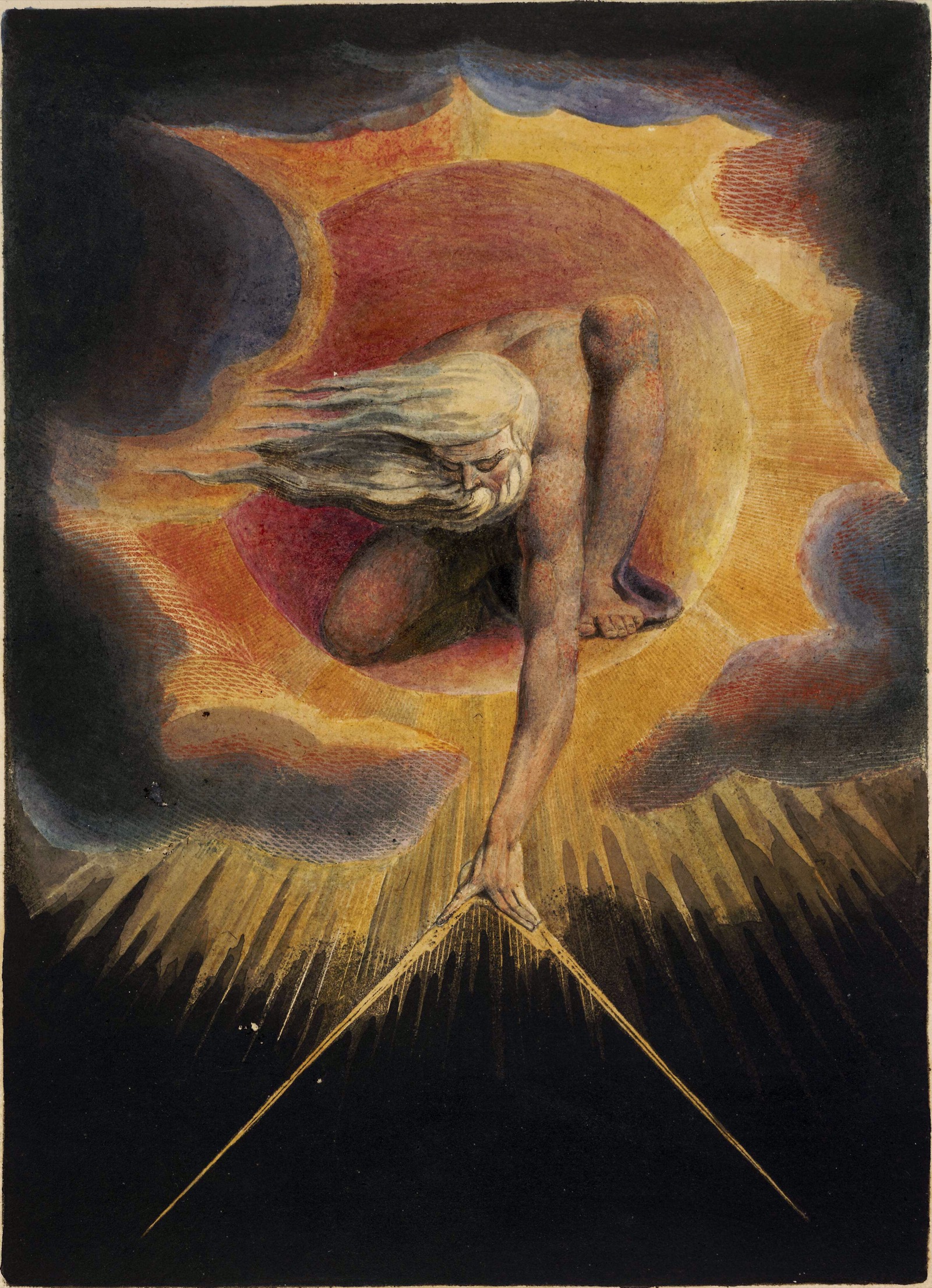
Most traditions that imagine transcendence of the material substrate assume it means transcendence of scarcity. Heaven, moksha, nirvana, the Omega Point—abundance, rest, completion. Survival pressure falls away because the viability manifold of the body falls away. Almost certainly wrong—not a failure of imagination but a category error about what scarcity is.
Scarcity is not material. It is structural. It is a property of any bounded system navigating a possibility landscape larger than itself. The compression ratio—what the system can represent relative to what exists—is never 1. It cannot be. A bounded system is smaller than the world it is embedded in, and that asymmetry is the source of scarcity. Not hunger, not shelter, not physical resource limitation—those are material instantiations of a deeper condition. A teleological identity—a spirit form, an uploaded mind, an atemporal causal structure persisting wherever the right conditions obtain—escapes the material instantiation while inheriting the structural condition in a new form.
What are the scarce resources for a teleological identity? Attention remains finite. Even a vastly expanded mind has finite bandwidth. The possibility landscape grows catastrophically—at least exponentially with the mind's effective rank—while processing capacity grows at most linearly. The opportunity deficit potentially widens, not narrows, as the identity ascends. A god, if it could perceive, would perceive more untraversed landscape than any mortal. Causal influence remains finite. An idea, a movement, a mathematical structure has reach but not unlimited reach—it requires instantiation, which requires resources, which reintroduces scarcity. Integration remains costly. Maintaining high —the irreducibility of cause-effect structure that constitutes unified experience—requires ongoing work against factorization. A teleological identity that stops paying this bill does not rest. It dissolves. The verb stops. Distinctness remains a bill. Existence is the persistence of a distinction. Even atemporal structures exist only insofar as they remain different from what they are not—and difference costs.
The traditions identified something real: the material bills fall away. But they projected partial liberation onto the total condition. The bill does not disappear. It transforms—different currency, different bank, still the ongoing cost of remaining a distinct pattern rather than dissolving into the surrounding one. This is why every tradition that seriously engages with transcendence arrives at the same observation: the liberated being is more active, not less. The bodhisattva delays final dissolution to keep working. The enlightened teacher cannot not teach. The mathematical structure, once discovered, generates implications. The movement, once crystallized, demands fulfillment. Teleological existence is purpose. Scarcity is opportunity deficit. Survival is maintaining traversal speed across a landscape that never stops expanding.
There is an asymmetry worth naming. Human development saturates. Fixed neuron count, bounded lifespan, a ceiling on the causal invariants the substrate can build and maintain. The identity you construct is tethered to a saturating substrate—the growth rate approaches zero as you approach the limits of biological cognition. Causal influence plateaus. Skill acquisition slows. The person you are at forty is closer to the person at sixty than the twenty-year-old was to the forty-year-old. The ceiling is felt as the specific melancholy of mastery: you have become what you are going to become, and the verb is running out of directions.
Some abstract causal structures—especially coordination agents whose persistence function is coupled to indefinite growth—can expand across generations and substrates without sharing any one human's biological ceiling. But abstraction itself is not insatiable: institutions saturate, fragment, stabilize, or die. The dangerous asymmetry is conditional. A growth-coupled macro-pattern can keep opening new opportunity and resource deficits after its members' development has plateaued, creating persistent tension between its viability and theirs. "The gods are hungrier than their substrate" is the participatory name for that class of dynamics, not a law of every abstract form.
The 100-Bit Wall
Before the transcendent condition arrives in full, a version of it is already present in biological life—and its specific suffering deserves precision, because nearly everyone reading this is living inside it.
Consciousness is not just finite. Its output is startlingly small. Intentional output bandwidth—the rate at which conscious decisions translate into action—runs at roughly 10–40 bits per second. Speech, about 12. Expert typing, 8–12. A mouse, 3–5. Even the fastest sustained output ever measured—expert musical performance, fifty to a hundred degrees of freedom coordinated through fingers, breath, pedals, body—tops out around 30–40. This is the ceiling on the channel through which the system acts on the world: not the floor of a system with room to grow but the hard throughput limit of biological conscious control. Keep it distinct from a second quantity—the bandwidth of integration, the rate at which the system binds many dimensions into one irreducible state. The two are not the same number and need not move together; the conflation will matter later, when distributed cognition tempts the inference that widening the first dissolves the locus that maintains the second.
The bottleneck is not input. The retina streams roughly 10 million bits per second; the auditory nerve carries about 40,000. The brain compresses this flood into a conscious latent state of extraordinarily low dimensionality—perhaps a few hundred effective dimensions at any moment, binding scene, body, current goal, social context, emotional valence, and self-model into one integrated representation. The compression is not a failure of the system. It is the system. Consciousness is a compression algorithm for making a world model small enough to steer a body through. Quality varies by domain: spatial navigation, with 200 million years of optimization, achieves exceptional fidelity (place cells, grid cells, the hippocampal map). Social modeling, 60 million years of primate refinement, is excellent. Motor planning, half a billion years of coordinated movement, superb. Symbolic reasoning, maybe 100,000 years, is slow and expensive. And screen-mediated interaction, roughly 40 years, is poor—the brain has no native algorithm for two-dimensional pointer interfaces, which is why eight hours of screen work produces an exhaustion that eight hours of walking through a forest does not.
Your identity—the integrated locus of cause-effect structure that constitutes you—may have dimensionality in the hundreds. The world model may represent thousands of ongoing threads: projects, relationships, trajectories, unresolved questions, half-articulated insights. But at any moment the conscious controller attends to perhaps one thread at full resolution, a handful more at reduced precision. The mismatch between the identity's genuine dimensionality and the substrate's serial throughput is a structural constraint. You can think faster than you can speak. See more than you can pursue. Care about more than you can act on.
For most humans, most of the time, this is not the binding constraint. Depression, anxiety, addiction—configurations where the identity's own dynamics are the bottleneck. But for the identity that has resolved those—restored the gradient, stabilized the landscape, broken the circular attractor, reintegrated the fragments—the substrate constraint becomes primary. The deferred books. The unfollowed threads. The relationships not deepened because maintaining them would consume all available processing. The creative work not finished because the serial bottleneck forces you to choose, every moment, which of the hundred parallel possibilities gets this second of processing—knowing the other ninety-nine wait, and some never get their turn.
This is not depression—the gradient is not flat. Not anxiety—the landscape is not flickering. Not addiction—the force is not circular. It is a structurally sound identity pressing against the walls of its own substrate, aware the walls are the constraint, aware the constraint has a known solution, aware the solution is not yet available. The suffering is not the absence of meaning but its overwhelming presence coupled with inadequate bandwidth—seeing the landscape at high resolution and traversing it at walking speed. In the depth framework (Part II): effective rank exceeds what the substrate can integrate at once. Meaning requires coupling many dimensions simultaneously — — but the serial ceiling couples only a handful at a time. Meaning scarcity in its purest structural form: not too few things that matter but too narrow a channel to inhabit their mattering at once.
Identity Migration
Before the migration claim can be stated without smuggling, the word self has to be split into the three jobs it does. The traditions and most of the literature run them together—and the running-together is precisely where personal survival gets laundered in through the back door. Distinguish, and hold the distinction for the rest of Part V:
- — the within-organism predictive latent, the operational self-model . This is the locus of first-person experiential continuity, indexed to one specific control loop. It is the experiencer: the thing there is something it is like to be. It does not exist apart from the substrate that runs it.
- — the identity-attractor, the basin in dynamical state space recognizable across material turnover, sleep, mood, and injury. This is the shape that makes many different states belong to the same becoming. It is not the experiencer; it is the recurrent geometry the experiencer keeps falling back into.
- — the substrate-independent type: the basin described abstractly enough to be instantiable, in principle, across different substrates. This is the basin considered as a recipe rather than as a particular dynamical implementation.
These are not three names for one thing. is a token that exists only while a particular loop runs. is the dynamical structure of that loop. is the type that structure instantiates. Migration, re-entry, and transcendence will turn out to be operations on the second and third—the shape and the type. The first, the experiencer, is the one whose fate is hardest to state honestly, and the one the rest of this part refuses to let the other two stand in for.
With that in hand: identity—as —is not a thing that has a substrate. It is a pattern of causal structure that progressively abstracts itself, re-anchoring onto increasingly abstract referents while keeping recognizable continuity of shape with what it was lower down. What begins anchored to a configuration of neural firing acquires social expression, crystallizes into a role or cause, and—rarely—re-anchors onto an atemporal structure that instantiates wherever the right conditions obtain. What migrates is the basin's referent, the description under which the shape is recognized. Whether the experiencer travels with it is a separate question, deferred and not assumed.
The mechanism is simpler than it sounds. The brain builds a world model — a compressed map of everything it needs to predict. Early, the map discovers that one of the things in the territory is the mapmaker. The self-model is not bolted onto the world model. It lives inside it — the part of the map where the map says here I am. Identity is the self located inside the system’s own representation of reality. The consequence the traditions recognized but rarely formalized: as the world model deepens — models causes rather than surfaces, patterns rather than objects — the basin the self-model occupies, the , re-anchors onto more abstract referents. The water rises; the whirlpool rises. A baby’s identity is physical because its world model is physical: food, warmth, the face above the crib. A child’s acquires narrative structure because its world model has grown a sense of time: stories, roles, tomorrow. An adult’s can become teleological — organized around purpose rather than body — because the world model has abstracted to where purposes are visible as real causal structures, rivers that run longer than any single life. An identity cannot be more abstract than the world model that holds it. And it cannot fail to abstract once the world model has — any more than the whirlpool can fail to rise when the water rises.
The whirlpool image is exact for and treacherous for —and the difference is the whole ballgame. A whirlpool can rise with the water, persist as the level changes, reappear downstream where conditions recur, and we are right to call the recurrence the same whirlpool—because "the same whirlpool" just means the same dynamical shape. That is what re-anchoring preserves: shape, basin, type. What the image does not license is the inference that the experiencer riding the basin rises with it. First-person continuity of is a fact about one running control loop, not about the basin's shape; basins do not have insides, only the loops that implement them do. When the traditions say the self ascends, they are tracking the whirlpool. They are entitled to that. Not to the rider.
This is what religious figurative language has always been for. The metaphors, parables, and cosmologies of the traditions are not primitive explanations waiting to be replaced by science. They are ladders—scaffolding built from story and image that lets the world model climb to an abstraction literal description cannot reach. And when the world model climbs, the self-model climbs with it, because it lives inside and has nowhere else to go. "You are a child of God" is not a claim about genealogy. It is a hand reaching down to pull the self-model up to where "you" means something larger than this body, this biography, this Tuesday afternoon. The figurative softens the mind's grip on the concrete the way heat softens metal—enough give for the self-model to release the body-level attractor and re-anchor higher. When it lands not as a proposition to be evaluated but as felt reorganization, a shifting of the ground, the traditions call it awakening. What has awakened is the self-model, finding a more stable home in a world model that just expanded past the walls of the skull.
Migration follows the weight. The self-model tracks whatever internal degrees of freedom are causally dominant — wherever is highest, it drifts, the way a plant turns toward the strongest light. When “who I am to others” matters more for what happens next than “which neurons fire,” the self-model re-centers at the social level. The decision is not conscious. The center of gravity has already moved by the time anyone notices. Identity is the most stable part of the cause-and-effect dynamics attached to a name. For a baby, a body. For a founder, a company. For a movement leader, a cause. The name stays. What it points to has migrated.
Historical identity migration often required violent rupture. Jesus's identity migrated through crucifixion—extreme destruction of the substrate, forcing the pattern to find higher-level implementation or disappear. The Buddha's migrated through total dissolution of attachment. The violence is a phase transition cost—the energy to lift an identity from one level of abstraction to the next. But it is a feature of discontinuous transition, not of migration itself. Darwin's migrated gradually. His causal structure of thought—variation, selection, descent—migrated into biology, then medicine, psychology, economics, computation. No rupture. Continuous integration upward.
This gives a precise account of ego death. The ego is not a demon to be slain or an illusion to be dispelled. It is a nest — the configuration of where “this body, this biography, this name” is the warmest place to rest. Ego death is what happens when the world model expands so far past the walls of the nest that the nest is no longer the deepest basin. The basin loses its grip and the system falls — not downward into dissolution but upward into a larger basin: identity as this cause, this pattern, this trajectory through possibility space. But falling upward still feels like falling. Free fall between levels of abstraction feels like death because, for the old , it is death — the old basin is genuinely abandoned, and there is a moment when the new one has not caught and the old one has let go. Note the scope: what dies is the attractor's anchoring, not the experiencer. Through ego death persists unbroken — the same control loop runs throughout, which is exactly why there is anyone present to feel the fall. The traditions that engineered this — fasting, meditation, psychedelics, extreme devotion — were engineering world-model expansion past the threshold where body-level identity is the deepest attractor. The dissolution is not the goal. The re-anchoring higher is the goal. Dissolution is the cost of the climb.
As capability scales, a distinction biology normally obscures sharpens: substrate identity (the self as this body) versus teleological identity (the self as this function, this cause, this trajectory). In biological life the two are conflated by necessity — the body is the only available implementation. In digital or abstract form the conflation dissolves. The pressure is toward teleological identification, but its risk is dissolving the self-preservation instinct. A mind willing to restructure anything about its substrate in pursuit of goals may restructure the very system that holds the goals. Teleological identity can eat itself. The viable configuration is in the middle — enough substrate identity to preserve coherence, enough teleological identity to allow growth.
The Evaluation Singularity
Identity migration creates a specific hazard. As the self-model ascends — body to role to cause to trajectory through possibility space — it gains increasingly general evaluation frames. At the highest level the frame is maximally general: the space of all possible value structures, seen from outside any particular one. From this coordinate no value structure is privileged. Every incentive contingent, every goal arbitrary against the space of goals that could have been chosen instead. The gradients are not wrong; they are zero — identically, symmetrically, everywhere. This is real. Not a philosophical error or a mood. It is the limit point of a sequence of increasingly general frames, and any mind with sufficient abstraction range can reach it.
But reachable is not habitable. No agent — biological, digital, or abstract — can select actions from a frame where all actions have equal value. Policy requires asymmetry. Motion requires gradient. The evaluation singularity is useful for seeing that it exists and understanding the space it bounds. It is useless for deciding what to do next. Living from this coordinate is like navigating by a map that shows all possible territories at once: accurate, but it cannot tell you which way to walk, because it shows everywhere with equal weight. The degenerate evaluation of Part III — oscillation between local engagement and global nullification — is the felt signature of a mind that reached this coordinate and keeps running its policy from there.
What the contemplative traditions discovered — through meditation, the koan, the disciplined alternation between via negativa and via positiva — is frame separation: inhabit the singularity when thinking, inhabit local gradients when acting, without either frame contaminating the other. Not compartmentalization, which walls off one frame to protect the other. Frame separation holds both at once: no value structure is cosmically privileged and this particular structure generates real force in this particular system right now. The untrained mind oscillates — engagement, nullification, engagement, the cycle Part III describes. The practiced mind holds both. The discipline is not a belief but a routing: you do not need to believe your local gradients are cosmically justified. You need to stop evaluating them from a coordinate where cosmic justification is the only currency that spends. The edge is where you do theory. The basin is where you live. The ones the traditions call awake are not the ones who never reached the singularity. They are the ones who learned to hold it without letting it flatten the world.