Lenia: What a Cellular Automaton Cannot Do
V2: The Evolution Series
Lenia with resource depletion and regeneration, evolved under drought. The measure is the change in partition-loss under severe drought.
| Version | (drought) | Lesson |
|---|---|---|
| (naive) | Decomposition baseline | |
| (homogeneous evolution) | Selection alone does nothing | |
| (heterogeneous chemistry) | Diverse viability manifolds help a little | |
| (hierarchical coupling) | evolved vs naive | Stress overfitting: more integrated and more fragile |
| (curriculum) | +1.2 to +2.7 points on novel stressors | The only intervention that generalized |
The shifts are small and reported without error bars. What held up: mild stress raised integration and severe stress collapsed it in every condition, most likely by pruning; evolution produced fragile integration; curriculum beat substrate complexity; and the substrate has a ceiling that no amount of resource dependence moves.
Study record: metadata, result path, seeds, source code, and key finding for .
V3–V6: The Substrate Ladder
Seven substrates, each adding one capability; four remain in the catalog. An attention variant, since removed, added evolvable attention and took the fraction of cycles with integration rising under stress from 3 to 42 percent, which stopped at the threshold rather than crossing it, and which later work showed was not the operative variable. added content-based coupling and became the foundation for the measurement passes. added chemotaxis; patterns forage. added memory channels; evolution kept longer memory in two of three seeds, the one substrate addition consistently selected for. A Hebbian-plasticity variant, removed, was the worst substrate: the extra degrees of freedom added noise faster than selection could filter it. A quorum-signaling variant, removed, had two of three seeds evolve to suppress signaling, and its record robustness came at a population of two. added a real membrane and had the best robustness, with internal gain evolving down in all three seeds. Evolution preferred permeable membranes to insulated cores.
| Version | Mean robustness | Max | Cycles above 1.0 |
|---|---|---|---|
| (content coupling) | 0.923 | 1.052 | 3/90 |
| (+ chemotaxis) | ~0.91 | ~0.95 | ~1/90 |
| (+ memory) | 0.907 | 1.070 | 3/90 |
| (boundary) | 0.969 | 1.651 | ~10/90 |
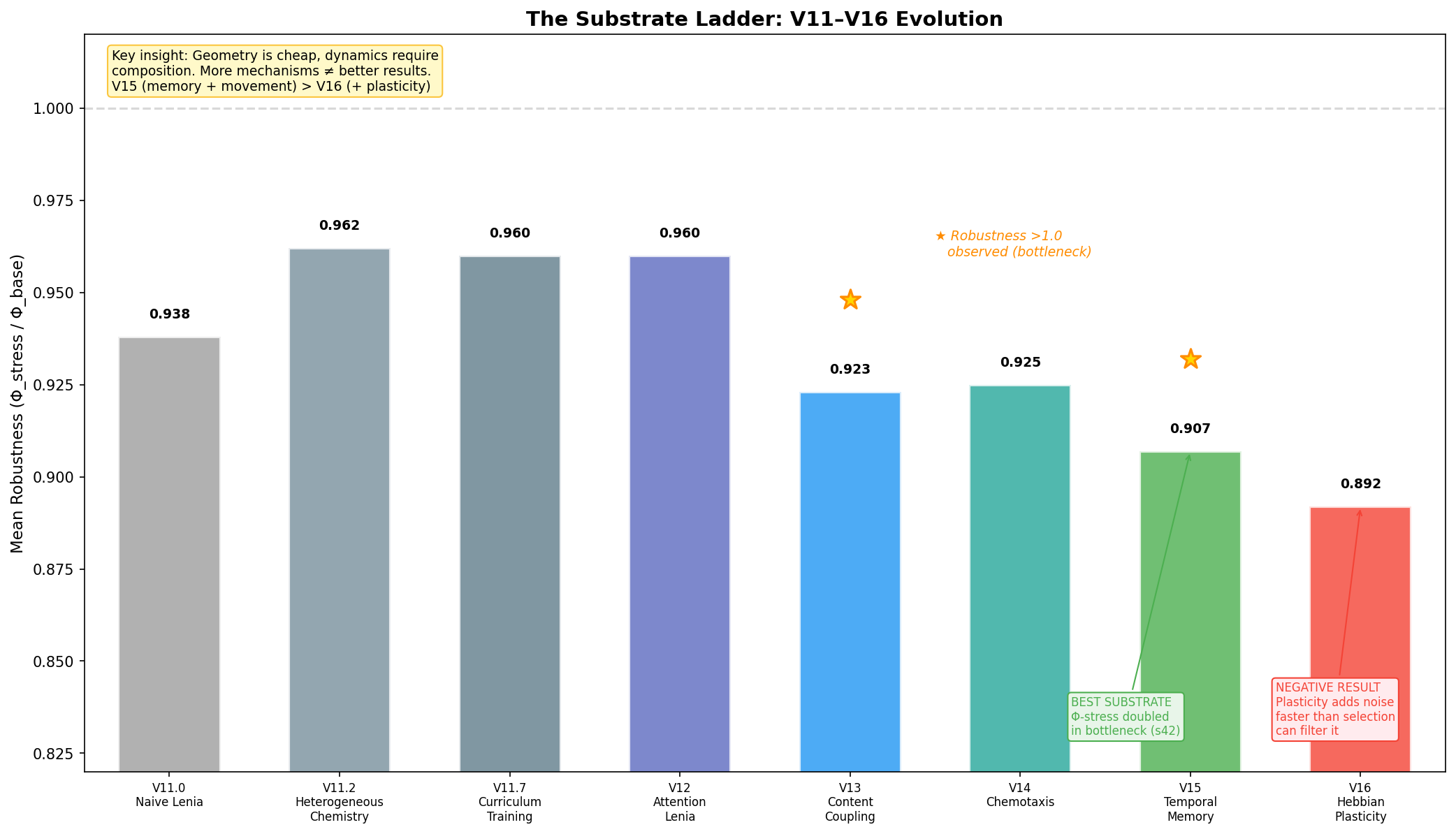
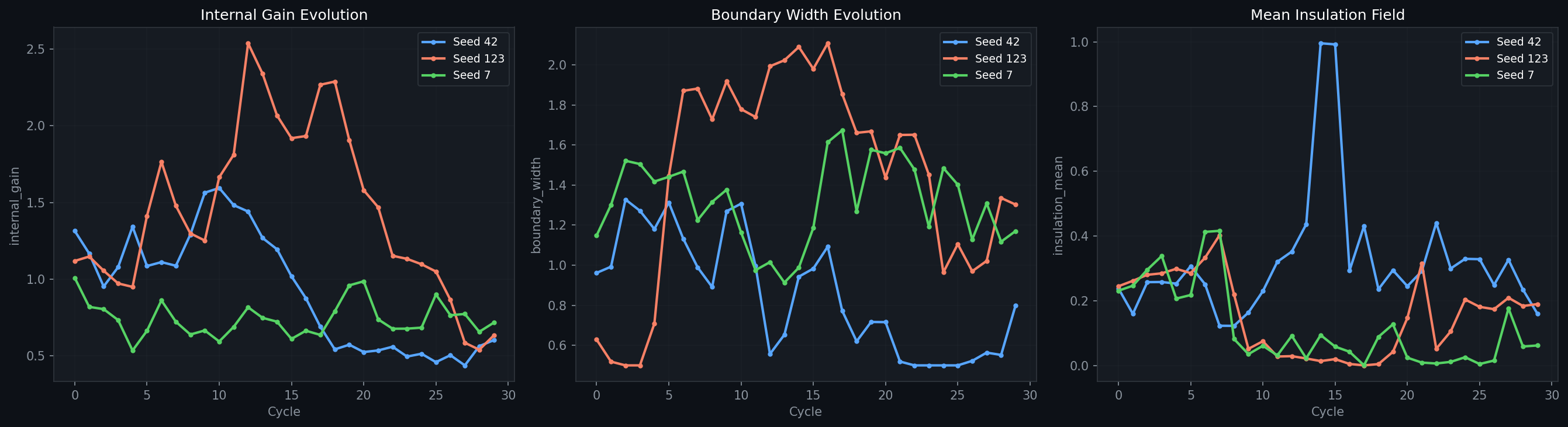
Every one of these stayed at . The FFT kernel mixes each cell's contribution into a global field every step, so nothing a pattern does survives to be re-sensed. There is no medium to close the loop through, internal or external. Within Lenia the architectural space was exhausted.
Study record: metadata, result path, seeds, source code, and key finding for .
Study record: metadata, result path, seeds, source code, and key finding for .
The Measurement Program on V3
Thirteen measurement passes over snapshots, three seeds, seven snapshots each, fifty recording steps per snapshot. Most of them are small, and the table says which.
| Measurement | Result |
|---|---|
| language | Mutual information above baseline in 15 of 20 snapshots; topographic correlation zero everywhere. A chemical commons, not a language. |
| counterfactual detachment | Null. from cycle zero. |
| self-model | Null, with one pattern in one seed at one cycle above threshold. |
| affect geometry | Structure-behavior RSA significant in 8 of 19 snapshots, rising in one seed. Same form as the alignment that collapsed under rotation-invariant re-test in . Suspected basis artifact; not re-tested. |
| normativity | Null. No valence asymmetry between cooperative and competitive contexts. Social context raised integration regardless of interaction type. |
Eight further passes, substrate engineering, existence, world model, representation, perceptual mode, social-scale integration, entanglement, and a capstone roll-up, were removed from the catalog in November 2026 as uninformative. Their code and results are in git history before commit 111a046.
Study record: metadata, result path, seeds, source code, and key finding for .